
Hookah / Shisha Charcoal
Cube, bar and tablet charcoal for hookah and shisha. Format and cube size decide heat output, burn per piece and how the coal sits on the bowl — this page compares the options and what each published figure is based on.
Pricing: quoted per specification, packaging and order volume — no fixed catalogue price. Request a quote →
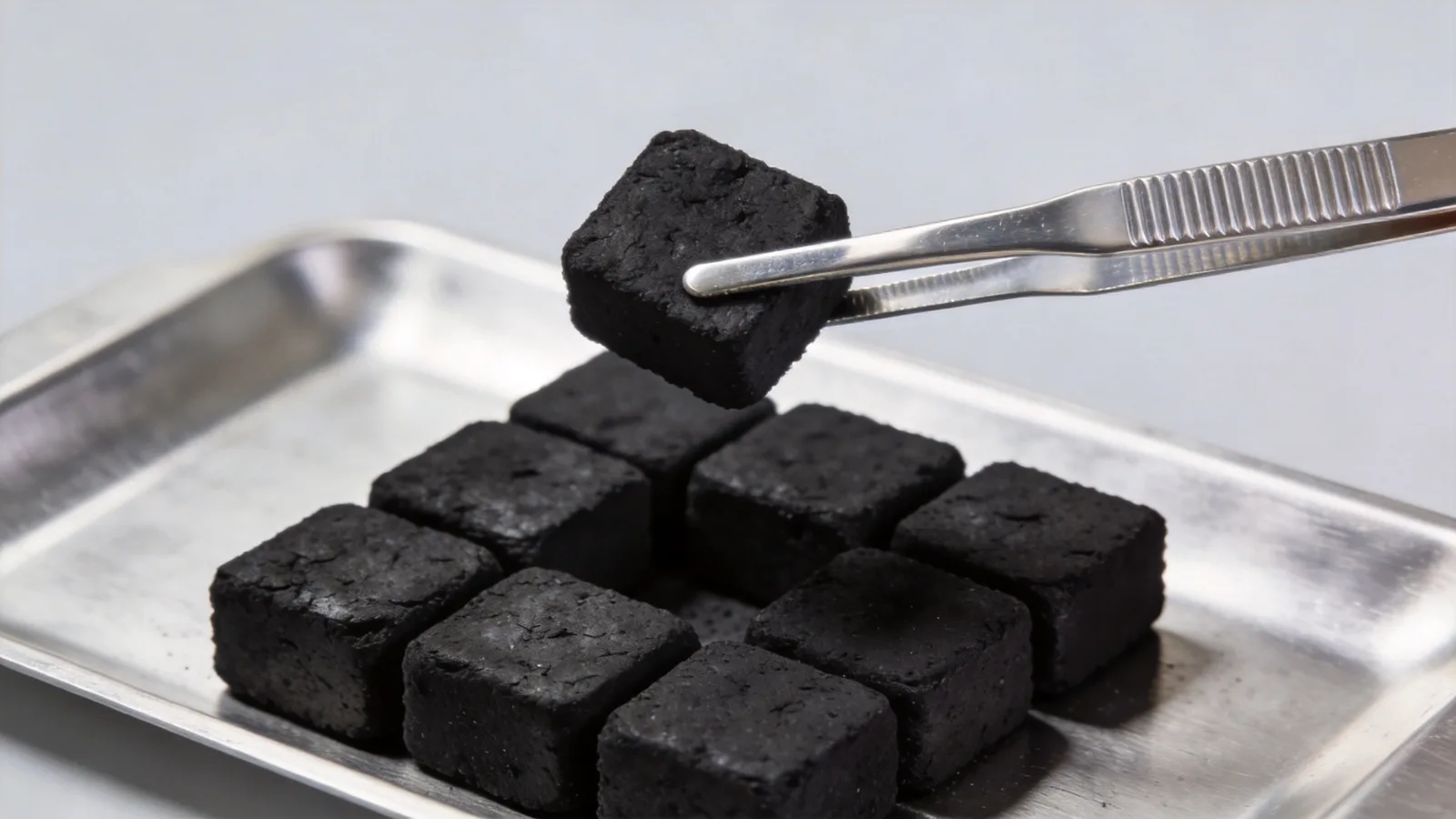
Supplier-declared means the value comes from a supplier's public listing or datasheet and has not been independently tested by Charcoal Hub. Industry reference means a class-level range from public sources. Data pending means we have no figure to publish. Burn time in particular is configuration-dependent — treat every number as a claim with a protocol attached.
At a Glance
| Item | What we can state |
|---|---|
| Formats | Natural cubes (22–27 mm), large block, coated bar, instant-light tablet |
| Raw materials | Coconut shell (natural cubes); bamboo and fruitwood (FireMax range) |
| Declared burn time | ~60 min for a 25 mm cube; 2–3 h for large blocks — supplier-declared |
| Declared ignition | 8–12 min on a coil burner; 15–50 s for instant-light |
| Evidence status | Supplier-declared — no independent test report on file |
| Price | No catalogue price — quoted per specification, packaging and volume |
Choosing a Format
| Format | How it behaves | Typical use |
|---|---|---|
| Natural coconut cube, 25–27 mm | Coil burner, 8–12 min to full glow; steady heat, low ash. | Seated lounge sessions, premium retail. |
| Large block, 40 × 40 × 30 mm | More mass per piece; long burn, fewer pieces per bowl. | Long sessions, large bowls. |
| Coated bar, 90 × 25 × 12 mm | Fast ignition via coating, long burn, even heat. | Lounges wanting speed without loose tablets. |
| Instant-light tablet, 33 mm | Lights from a flame in under a minute; chemical ignition layer. | Outdoor use, backup, fast turnover. |
Cube Sizes and What Changes
| Nominal cube | Approx. pieces per kg | What changes in a session |
|---|---|---|
| 22 mm | ~96 | Finer heat steps; more pieces to manage; shorter burn per piece. |
| 25 mm | ~72 | The common default — moderate heat, predictable burn. |
| 26 mm | ~64 | More mass and burn per cube at a similar footprint. |
| 27 mm | ~56 | Higher heat per piece; sits better on larger bowls. |
Heat, Burn and Session Length
Burn time is the most quoted and least comparable figure in this category. A cube has no burn time in the abstract — only one under a particular airflow, bowl, lid position, ambient temperature and coal arrangement. Move the same cube from a windless lounge to a terrace and the number changes, which is why a supplier claim of “120 minutes” and a user report of “60 minutes” can both be honest.
What a buyer can compare is mass per piece and declared ash. A larger cube carries more fuel and tends to hold heat longer, at the cost of a hotter initial phase. Lower ash means less residue in the bowl. Neither guarantees a better session — the pack, the bowl and the draw matter as much as the coal.
For a lounge, the metric is cost per session, not cost per kilogram: how many cubes a bowl needs, how often staff replace them, and how much unburnt charcoal is discarded. A cheaper cube that needs replacing twice is not cheaper.
Ignition: Natural vs Quick-Light
Natural cubes are lit on an electric coil burner or with a gas torch and reach full glow in roughly 8–12 minutes. The wait is the trade-off for a fuel with no ignition chemicals in the coal itself.
Instant-light tablets and coated bars carry an ignition layer that catches from a flame in 15–50 seconds. That layer is why they light fast and why some venues keep them separate from natural coal: the first minutes of combustion include the coating. Light them in a ventilated area, away from the bowl, and let the coating burn off before the coal goes on the bowl.
Budget for ignition hardware too. A lounge running natural cubes needs enough coil burners for peak covers, and burner condition affects ignition time as much as the charcoal.
Ash, Odour and Spark
Ash is the residue left after combustion. In hookah use it affects how the coal sits as it burns down and how much cleaning each session needs. A declared maximum is more useful than a declared typical value, because the typical figure is not what an out-of-spec batch delivers.
Odour is harder to specify. Coconut shell is chosen partly because it is relatively neutral, but neutrality is a session property — it depends on the shell, binder, carbonization and storage. Test odour on a blind sample in your own bowl; “odourless” on a datasheet is a claim, not a measurement.
Sparking is a safety and comfort issue rather than a quality grade. Denser, well-dried cubes generally spark less, but tongs, distance and placement all change the risk.
Declared Values on Record
One public listing carries a full set of values for the 25 mm natural coconut shell hookah cube. The 26 mm and 27 mm records carry size-class data only.
| Parameter | Declared value | Method cited | Status |
|---|---|---|---|
| Fixed carbon | ≥ 80% | ASTM D3172 | Supplier-declared |
| Volatile matter | ≤ 12% | ASTM D3175 | Supplier-declared |
| Ash content | ≤ 3.5% (typical 3.0%) | ASTM D3174 | Supplier-declared |
| Moisture | ≤ 5% | ASTM D3173 | Supplier-declared |
| Sulphur | ≤ 0.1% | ASTM D4239 | Supplier-declared |
| Burning time | ~60 min per 25 mm cube (claims up to 120 min) | None — condition-dependent | Supplier-declared |
| Ignition time | 8–12 min | None stated | Supplier-declared |
The FireMax Range on Record
Four further products are recorded from a FireMax datasheet provided 2026-10-10. All are supplier-declared and none has been independently tested. Declared values sit side by side to show format differences — not a ranking.
| Product | Format | Burn | Ignition | Ash | Packaging |
|---|---|---|---|---|---|
| FireMax SL470 | Bamboo block, 40 × 40 × 30 mm | 2–3 h | 9–10 min | 3.5–5% | 12 kg bag + carton |
| FireMax C25 | Bamboo cube, 25 mm | 90–120 min | 9–10 min | Grade S: 3.5–5% | 10 kg carton |
| FireMax SI87 | Coated bar, 90 × 25 × 12 mm | 90–110 min | 35–45 s | 3.5–4.5% | 60 pcs/box, 24 boxes/carton |
| FireMax RB33 | Instant-light tablet, 33 mm | 45–70 min | 15–50 s | Printed as 0.045 — unconfirmed | 10 pcs/roll, colour-specific cartons |
Packaging and Order Shape
The 25 mm natural record lists 1 kg moisture-resistant colour boxes (72 cubes), retail packs of 1 / 1.2 / 2 / 10 kg and master cartons of 10 or 20 kg. The FireMax lines differ — 10 kg cartons for C25, 60-piece boxes for SI87, 10-piece rolls for RB33. That matters commercially: a mixed pallet means several carton specifications, barcodes and artworks.
Loading is declared at roughly 14.4 tonnes for a 20′ GP and 23.4 tonnes for a 40′ HQ on the natural cube record. Treat those as nominal — packing density, carton size and palletisation change the real figure. Confirm the load plan before booking freight.
Packaging services → · Guide: packaging options · Guide: container loading
Where Hookah Charcoal Goes Wrong
- Burn-time inflation. A claim measured in still air with a closed lid will not survive a busy terrace. Ask for the protocol.
- Ash above the ceiling. A “typical 3%” batch can arrive at 5%; without a maximum in the PO there is no remedy.
- Odour from binder or storage. The most common complaint that never appears on a datasheet.
- Cracking and fines. Under-dried cubes crack; over-dry cubes break in the carton — both leave dust in the box.
- Coating inconsistency. Patchy coating means uneven ignition across a roll.
- Mixed batches. Several runs in one shipment make every comparison unreliable. Ask for one batch per SKU.
Buyer Checklist
- Format first. Decide natural vs quick-light before comparing price — different products, different costs.
- Size and tolerance. Confirm the nominal cube and permitted tolerance; verify with calipers.
- Method and basis. Ask which method produced each figure and whether it is dry or as-received.
- Batch linkage. Ask which batch and date each number describes.
- Raw report. Request the laboratory report, not a summary PDF.
- Session test. Assess odour, spark and heat on a blind sample in your own bowl.
- Moisture at both ends. Test at origin and on arrival; the difference shows what the packaging does.
- Acceptance clause. Agree sampling and the remedy for an out-of-spec arrival.
Sampling and Verification Path
- Request a sample in the exact format and size you intend to sell. Sample request form →
- Run a session test with your own burner and bowl; record ignition, burn and ash behaviour per cube.
- Ask for the batch report before the bulk order, then re-check on arrival.
Method references: burn time, ignition time, ash content, odour. None of those pages contain results.
Verification Status
No hookah charcoal product has yet been independently verified by Charcoal Hub. Published figures are supplier-declared and labelled as such. Verified test reports will be published on the testing sub-site as they become attributable.
Frequently Asked
Which cube size should a hookah lounge buy?
Match the cube to the bowl and the session length you serve. 25 mm is the common default, 26 mm adds a little burn per piece, and 27 mm suits larger bowls or longer sessions. Buy samples of two sizes and compare them in your own setup before committing a container.
Is instant-light charcoal acceptable for commercial use?
It is legal and widely used where speed matters, but it lights with a chemical layer that some venues and guests prefer to avoid. Many lounges run natural coconut cubes for seated sessions and keep quick-light tablets for backup or outdoor use. The choice is operational, not a quality verdict.
Why do burn-time claims differ so much between suppliers?
There is no universal test. Burn time depends on cube mass, airflow, burner or wind conditions, bowl setup and how the coal is arranged. A supplier measuring in still air with a closed lid reports a longer figure than one measuring in a windy bay. Ask for the protocol before comparing numbers.
Do you sell fixed-price hookah charcoal?
No. Price depends on cube size, ash grade, packaging, order volume and destination port. Send the specification through the quote form and the offer is built around it — there is no catalogue price to quote from.
Related
25 mm product record data
Supplier-declared values with source and status.
Burning time methodology data
Why burn time has no universal standard and how to compare claims.
Burn-time test method testing
How burn time is assessed under a defined protocol.
Manufacturing guide pillar
Process stages, density and the QC gates that keep batches consistent.
How to choose knowledge
A buyer decision framework for hookah charcoal.
25 mm vs 26 mm knowledge
What the size difference actually changes in a session.
Quick-light vs natural knowledge
The operational trade-off behind the two ignition classes.
Odour and ignition knowledge
Why odour is a session property, not a spec-sheet line.
Density and heat management knowledge
How mass per piece changes the heat curve.
Request samples
Test a batch in your own hardware before ordering.