
Coconut Shell Charcoal
Natural charcoal from carbonized and pressed coconut shell — the feedstock standard for hookah cubes and a dense, low-ash option for BBQ. Which numbers matter, and what each figure represents.
Pricing: quoted per specification, packaging and order volume — no fixed catalogue price. Request a quote →
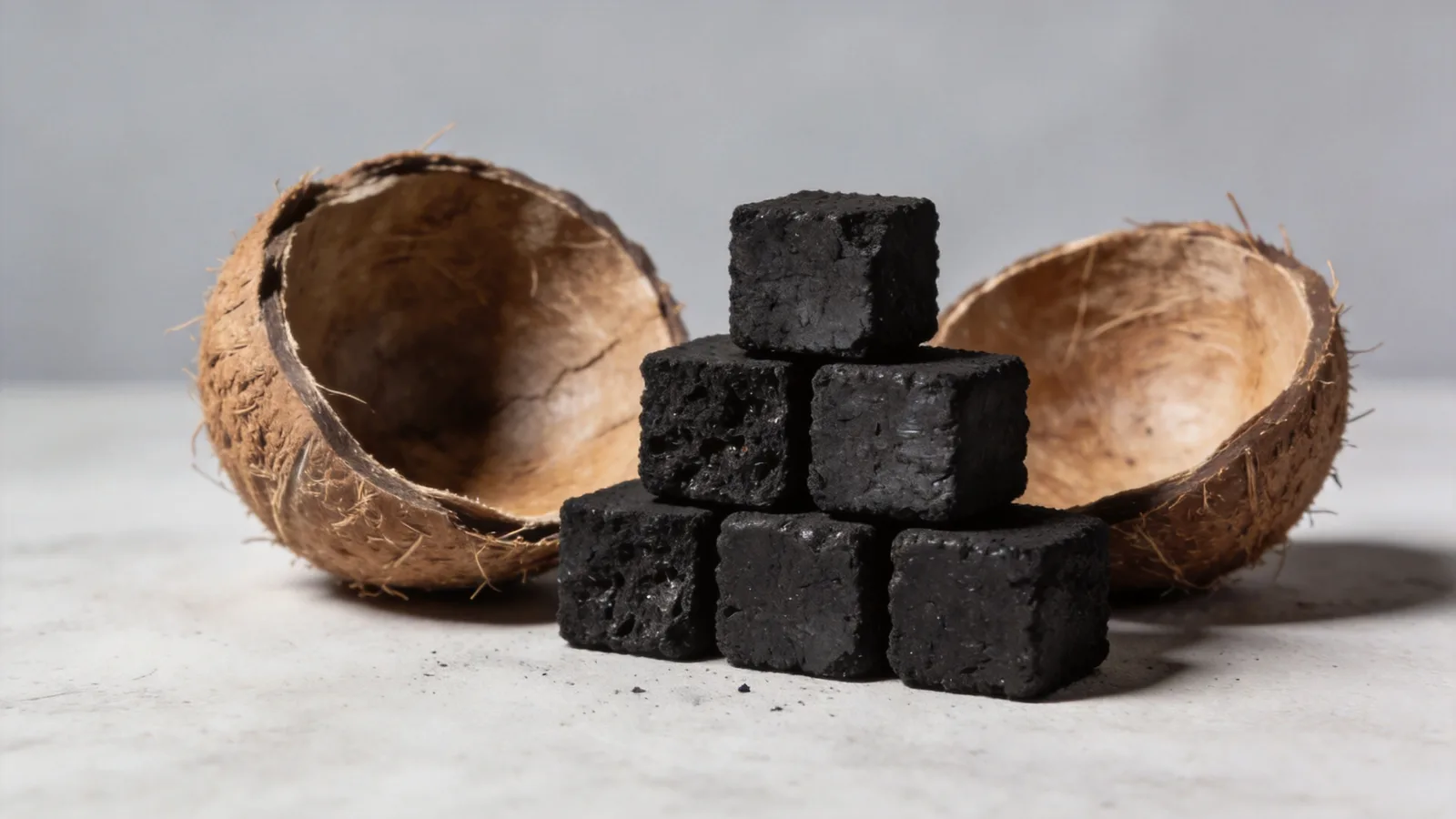
Supplier-declared means the value comes from a supplier's public listing or datasheet and has not been independently tested by Charcoal Hub. Industry reference means a class-level range from public sources — useful for orientation, never a factory commitment. Data pending means we have no figure to publish. No laboratory results here.
At a Glance
| Item | What we can state |
|---|---|
| Raw material | Coconut shell — as described in the source listing |
| Standard formats | 22 / 25 / 26 / 27 mm nominal cubes; other shapes by arrangement |
| Declared chemistry | 25 mm only: fixed carbon ≥ 80%, ash ≤ 3.5%, moisture ≤ 5%, volatiles ≤ 12% |
| Evidence status | Supplier-declared — no independent test report on file |
| Manufacturer | Not yet verified by Charcoal Hub |
| MOQ | 1 tonne on stock packaging; one 20′ container for printed OEM boxes (supplier-declared) |
| Price | No catalogue price — quoted per specification, packaging and volume |
What Coconut Shell Charcoal Is
Coconut shell charcoal is the product of heating coconut shells — the hard endocarp left after the meat and husk are removed — in a low-oxygen environment. The shells carbonize rather than combust, driving off water and volatile compounds and leaving a carbon-rich solid. That solid is crushed, optionally mixed with a binder, pressed into cubes, dried and sorted.
The feedstock matters because coconut shell is denser than most wood charcoal. A denser piece holds more mass in the same volume, which generally means a longer burn and less ash per session — the two properties that made coconut the default for hookah charcoal and a premium option for BBQ.
It is not automatically better: density varies with origin, binder changes ash behaviour, and a badly dried cube can crack in transit. The category sets expectations; the batch decides.
How a Coconut Shell Cube Is Made
The process below is the conventional route. Equipment, temperatures and binder choices differ between factories, so treat it as a map of what to ask about.
- Carbonization. Shells are heated in a kiln, retort or drum with limited air. Public references put the window at roughly 600–900 °C; too low leaves volatiles, too high wastes yield.
- Cooling and grading. Char is cooled and screened; fines, unburnt shell and oversized pieces are separated.
- Milling. Char is ground to a controlled particle size, which affects how tightly the cube presses and how it burns.
- Binder mixing. Many pressed cubes use cassava or tapioca starch as binder. Ask whether the line is binderless if that matters.
- Pressing. The mix is formed into cubes under pressure. Die wear is one reason actual size drifts from nominal across a run.
- Drying and sorting. Cubes are dried to target moisture, then screened for size, cracks and breakage before packing.
Specifications That Decide a Purchase
| Parameter | What it tells you | Question to put to the supplier |
|---|---|---|
| Fixed carbon | Energy density; contributes to burn time and heat stability. | Which method, and is the result dry or as-received? |
| Ash content | Residue after combustion; lower ash means less cleanup and less bowl interference. | Is the figure typical, or a guaranteed maximum? |
| Moisture | Ignition behaviour, weight stability and shelf life. | Measured at the factory or on arrival? |
| Volatile matter | Ignition behaviour and smoke during lighting. | Does the value describe the char or the finished cube? |
| Size and tolerance | Fit to the bowl or grate, and consistency between pieces. | Nominal size plus permitted tolerance in millimetres? |
| Burning time | How long one piece sustains usable heat. | Measured under what burner, airflow and bowl setup? |
| Ignition time | Time to full glow on a coil burner or with a flame. | Average or worst case across a batch? |
Declared Values on Record
One public listing carries a full set of values for the 25 mm natural coconut shell hookah cube. They are reproduced with their status made explicit, because a number without provenance is not usable in a purchase decision.
| Parameter | Declared value | Method cited | Status |
|---|---|---|---|
| Fixed carbon | ≥ 80% | ASTM D3172 | Supplier-declared |
| Volatile matter | ≤ 12% | ASTM D3175 | Supplier-declared |
| Ash content | ≤ 3.5% (typical 3.0%) | ASTM D3174 | Supplier-declared |
| Moisture | ≤ 5% | ASTM D3173 | Supplier-declared |
| Sulphur | ≤ 0.1% | ASTM D4239 | Supplier-declared |
| Calorific value | 7,000–7,500 kcal/kg | ASTM D5865 | Supplier-declared |
| Burning time | ~60 min per 25 mm cube (claims up to 120 min) | None — condition-dependent | Supplier-declared |
| Ignition time | 8–12 min | None stated | Supplier-declared |
The 26 mm and 27 mm records carry size-class data only — pieces per kilogram. No batch chemistry is published for those sizes, and we will not copy the 25 mm figures across. A value stays unknown until a supplier provides it in writing.
Size Classes and Cube Count
| Nominal cube | Approx. pieces per kg | Practical implication |
|---|---|---|
| 22 × 22 × 22 mm | ~96 | Smaller pieces, finer heat control, more pieces per session. |
| 25 × 25 × 25 mm | ~72 | The common default; moderate heat and burn per cube. |
| 26 × 26 × 26 mm | ~64 | Slightly longer burn per cube, slightly fewer pieces per kilo. |
| 27 × 27 × 27 mm | ~56 | Largest standard cube; higher heat per piece, suited to larger bowls. |
Packaging, Container Load and Lead Time
| Item | Declared value | Status |
|---|---|---|
| Retail packs | 1 / 1.2 / 2 / 10 kg | Supplier-declared |
| Inner box | 1 kg moisture-resistant colour box, 72 cubes | Supplier-declared |
| Master carton | 10 kg or 20 kg, customer-specified | Supplier-declared |
| 20′ GP load | approx. 14.4 tonnes | Supplier-declared |
| 40′ HQ load | approx. 23.4 tonnes | Supplier-declared |
| Port of loading | Shanghai / Ningbo / Shenzhen | Supplier-declared |
| OEM lead time | 15–25 days after artwork approval | Supplier-declared |
MOQ, Private Label and Order Shape
The 25 mm record states a minimum of 1 tonne on stock packaging and one 20′ container for printed OEM boxes. Those are one supplier's terms, not an industry standard: MOQ depends on the line, the packaging run and artwork setup.
Private label typically covers box colour, logo, multilingual panels, barcode and batch coding. The same line is described as running 22, 25, 26 and 27 mm cubes. Ask for an artwork proof and a physical pre-production sample before the full run — a screen proof will not show print registration on moisture-resistant board.
Private label process → · OEM sourcing → · Guide: private label charcoal
Where Quality Goes Wrong
- Moisture pickup. Charcoal is hygroscopic; a cube that left at target moisture can arrive soft and slow to light.
- Ash surprises. A typical value is not a maximum; without a ceiling in the PO the figure is unenforceable.
- Size drift. Die wear and drying shrinkage move actual dimensions. Tolerance, not nominal size, is the spec.
- Binder and odour. Binder type and ratio can leave an odour that only shows up in a session.
- Breakage. Thin-walled cubes and loose cartons produce fines. Inspect a carton from the middle of the load.
- Batch mixing. Orders from several runs can differ carton to carton — ask for one batch per shipment.
Buyer Checklist
- Method and basis. Ask which method produced each figure (ASTM / ISO / GB) and whether it is dry or as-received.
- Batch linkage. Confirm which batch and date each number describes — a figure without a batch is not enforceable.
- Raw report. Request the laboratory report itself, not a summary PDF or marketing datasheet.
- Moisture at both ends. Test at origin and on arrival; the difference shows what the packaging is doing.
- Size and tolerance. Confirm the nominal class and permitted tolerance, then verify with calipers on a random sample.
- Feedstock purity. Ask whether the shell is single-origin or blended, and whether any wood char is included.
- Binder declaration. Ask what binder is used and at what ratio, or whether the line is binderless.
- Acceptance clause. Agree sampling and the remedy for an out-of-spec arrival before ordering.
Sampling and Verification Path
A datasheet narrows the shortlist; a sample decides it. The sequence is short:
- Request a sample of the exact size and packaging you intend to buy. Sample request form →
- Test it in your own setup — your burner, bowl and session length — and record ignition, burn and ash behaviour.
- Ask for a batch test report before the bulk order, then repeat the check on the arrived container.
Method references are on the testing sub-site and structured records in the product database.
Verification Status
No coconut shell charcoal product has yet been independently verified by Charcoal Hub. Every figure is supplier-declared and labelled; no manufacturer is named as verified. Test reports, when attributable, will be published on the testing sub-site.
Frequently Asked
Is coconut shell charcoal better than wood charcoal?
It is denser than most wood charcoal, so a cube of the same size tends to burn longer and leave less ash by mass. Whether that matters depends on the application: hookah buyers pay for density and odour neutrality, BBQ buyers may want a different burn profile. There is no universal ranking — compare batch values, not categories.
What is the difference between 25 mm, 26 mm and 27 mm cubes?
Nominal edge length changes the mass of each piece, the count per kilogram and the burn per cube. Public size-class tables put the count at roughly 72 cubes/kg for 25 mm, 64 for 26 mm and 56 for 27 mm. The right size depends on bowl geometry and session length, not on a quality hierarchy.
Do you publish a price per tonne?
No. Charcoal is quoted per specification, packaging, order volume and destination port, and the raw material varies by batch. A published figure would be misleading. Send the specification and volume you need and the offer is built around it.
Can I test a batch before placing a bulk order?
Yes — sample requests go through the sample form. Quantity, courier and any sample cost are confirmed per destination. Test the sample with your own burner, bowl and routine rather than relying on a datasheet alone.
Related
Full buyer’s guide
Specification, size grades, datasheet reading and a verification sequence.
25 mm product record data
Supplier-declared specification values with source and status.
Ash content methodology data
What ash measures and where the number stops being comparable.
Ash test method testing
The method behind the figure, with its limitations stated.
Testing and COA guide pillar
How to read a certificate, and what to verify without a lab.
How it is made knowledge
Carbonization, pressing and drying explained for buyers.
How to compare suppliers knowledge
A buyer guide to reading and comparing spec sheets.
MOQ explained knowledge
What drives minimum order quantity and how to negotiate it.
Packaging options knowledge
Retail boxes, master cartons and what survives a container.
Shipping and UN 1361 knowledge
Dangerous-goods basics for charcoal shipments.
Request samples
Verify a batch yourself before committing to volume.