
Bamboo Charcoal
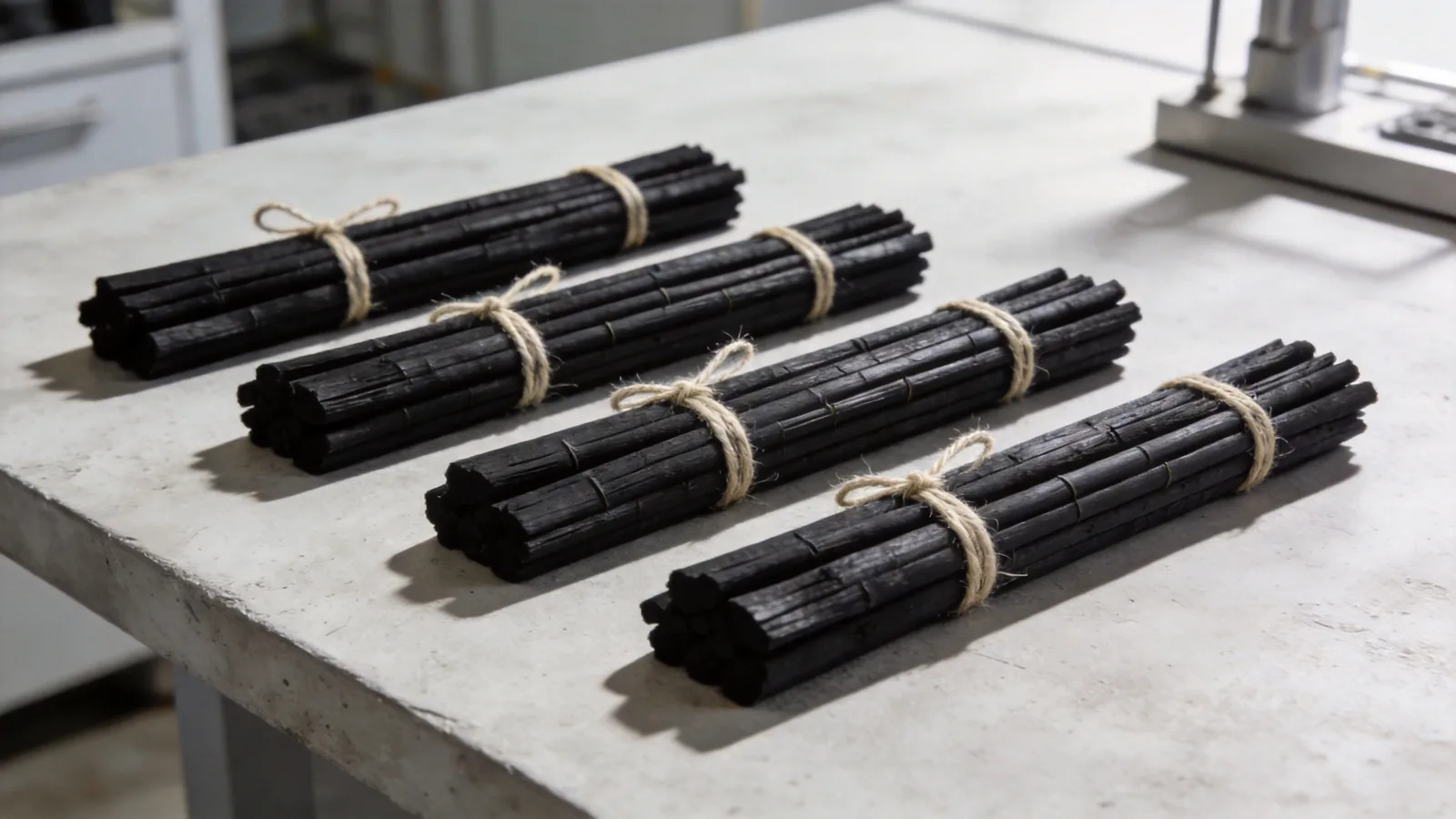
Bamboo carbonized and pressed into hookah cubes and bars. Lighter than coconut shell and faster to ignite, with three supplier-declared formats on record — and a datasheet that leaves several fields unresolved.
Pricing: quoted per specification, packaging and order volume — no fixed catalogue price. Request a quote →
Supplier-declared means the value comes from a supplier datasheet and has not been independently tested by Charcoal Hub. Industry reference means a class-level statement about how bamboo charcoal generally behaves. Data pending means the field is empty in our records and we will not fill it by inference. No laboratory results here.
At a Glance
| Item | What we can state |
|---|---|
| Raw material | Bamboo, carbonized and formed into cubes or bars |
| Documented formats | 40 × 40 × 30 mm cube; 25 × 25 × 25 mm cube; 90 × 25 × 12 mm silver bar |
| Documented application | Hookah / shisha; the bar record also lists incense |
| Declared ash | 3.5–5% across the three records (supplier-declared) |
| Declared burn time | 90 min – 3 h depending on format (supplier-declared) |
| Fixed carbon / volatiles | Data pending — null in all three records |
| MOQ | Data pending — not declared |
| Private label | Data pending — not declared |
| Manufacturer | Not verified; datasheet brand is FireMax |
| Price | No catalogue price — quoted per specification, packaging and volume |
What Bamboo Charcoal Is
Bamboo charcoal is made by carbonizing bamboo — typically culms and process offcuts — in a low-oxygen kiln or retort, then milling the char and pressing it into a finished shape. The carbonization step drives off water and volatiles and leaves a carbon-rich solid; the pressing step decides the final density, and therefore how the piece burns.
Bamboo grows faster than most hardwood feedstocks, which is why it appears in sustainability-oriented marketing. That is a feedstock-supply argument, not a performance argument: the finished cube still has to be judged on density, ash, moisture and burn behaviour like any other charcoal.
Industry reference Bamboo charcoal is generally less dense than coconut shell charcoal. For the same nominal cube size that means less mass per piece, a faster ignition and a shorter burn — which is exactly what the declared figures below show, with 90–120 minutes for the 25 mm cube against a 60-minute user-reported baseline for the coconut equivalent.
The Three Formats on Record
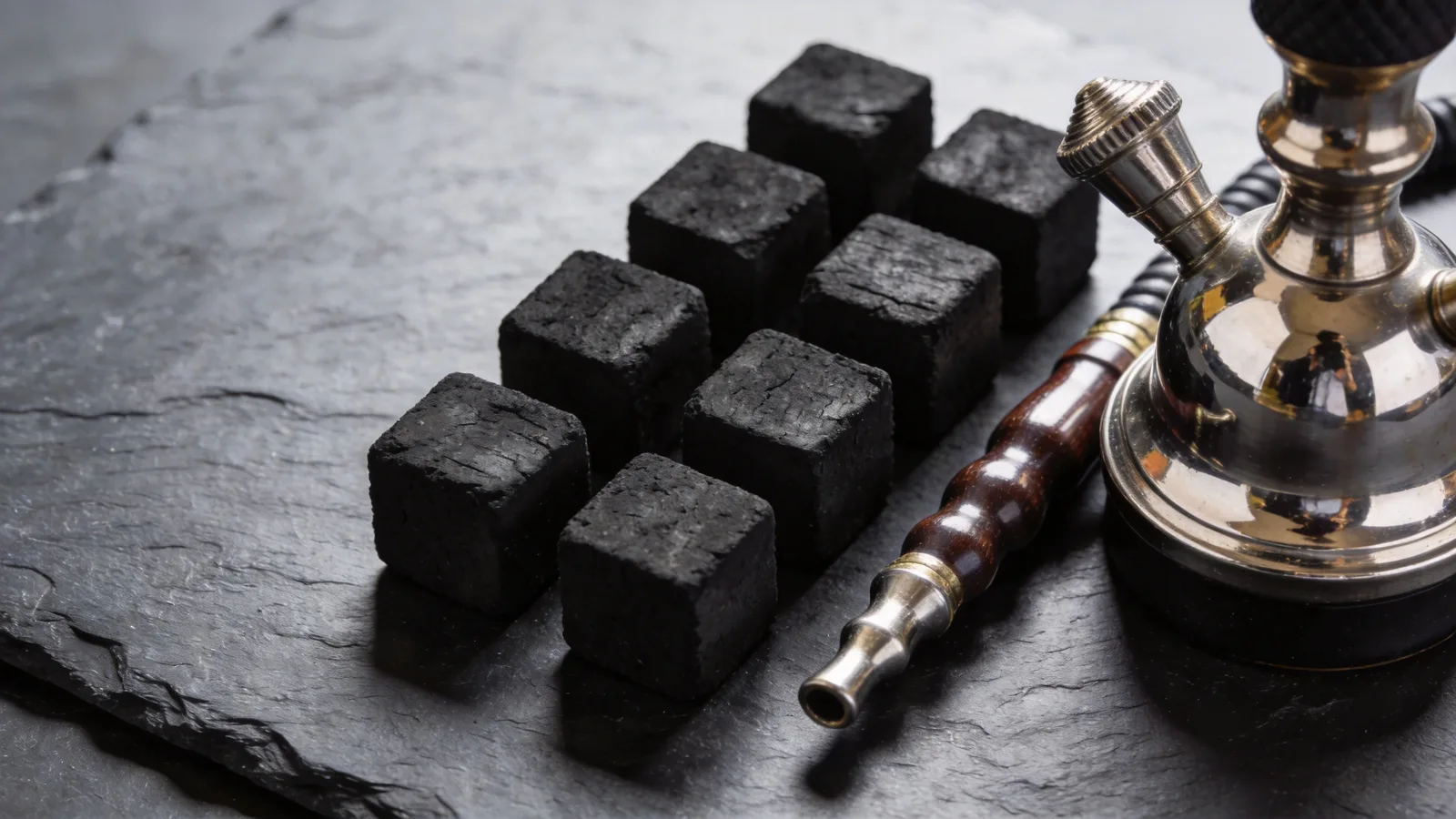
Three FireMax bamboo products are published in the product database. All three carry supplier-declared status; none has been independently tested. They are reproduced here with the source named, because a figure without provenance cannot carry a purchase decision.
| Product | Format | Burn | Ignition | Ash | Packaging |
|---|---|---|---|---|---|
| SL470 | 40 × 40 × 30 mm cube | 2–3 h | 9–10 min | 3.5–5% | 12 kg G.W., PE inner bag + brown carton |
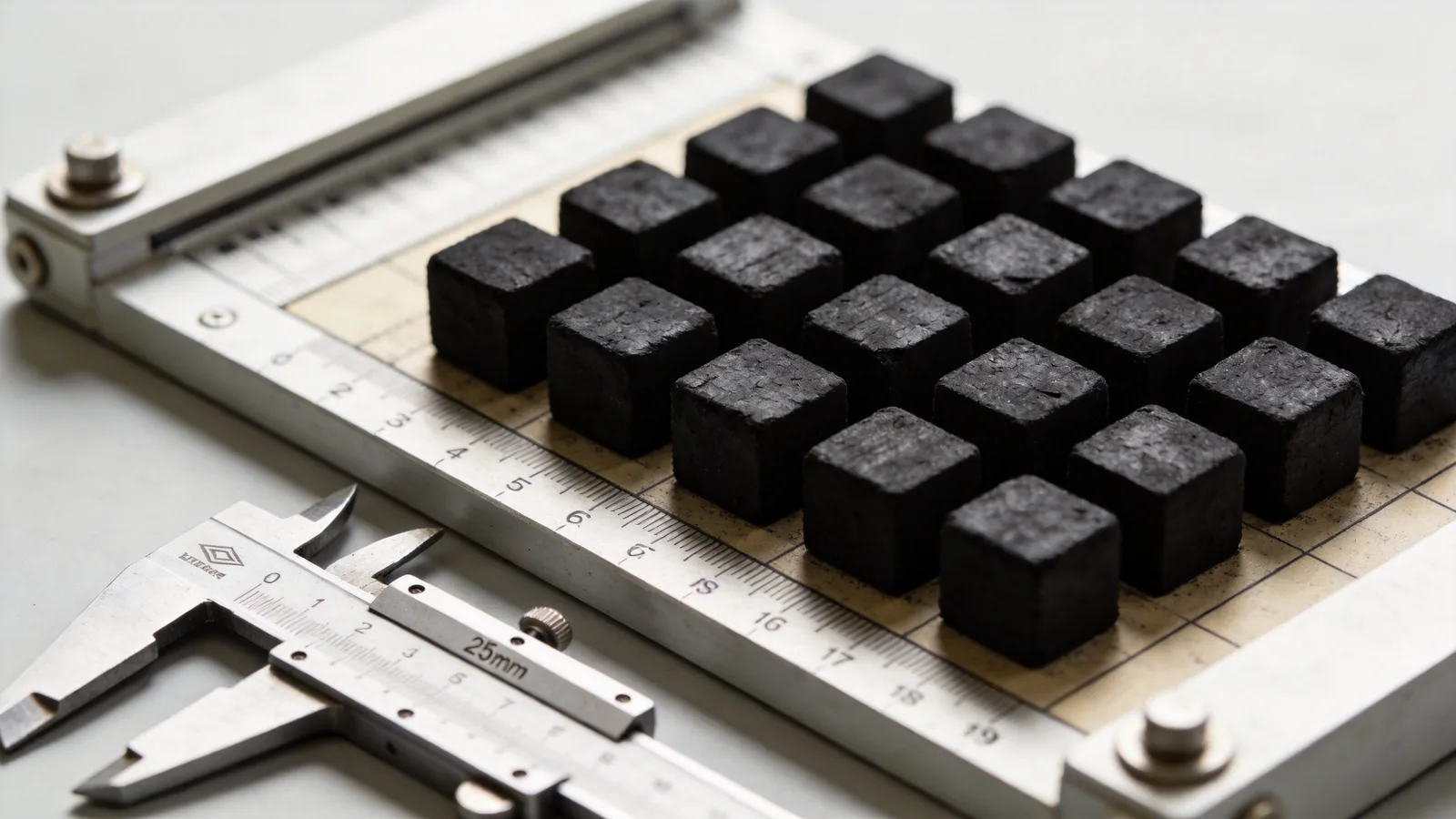
| C25 | 25 × 25 × 25 mm cube | 90–120 min | 9–10 min | Grade S: 3.5–5% | 10 kg per carton |
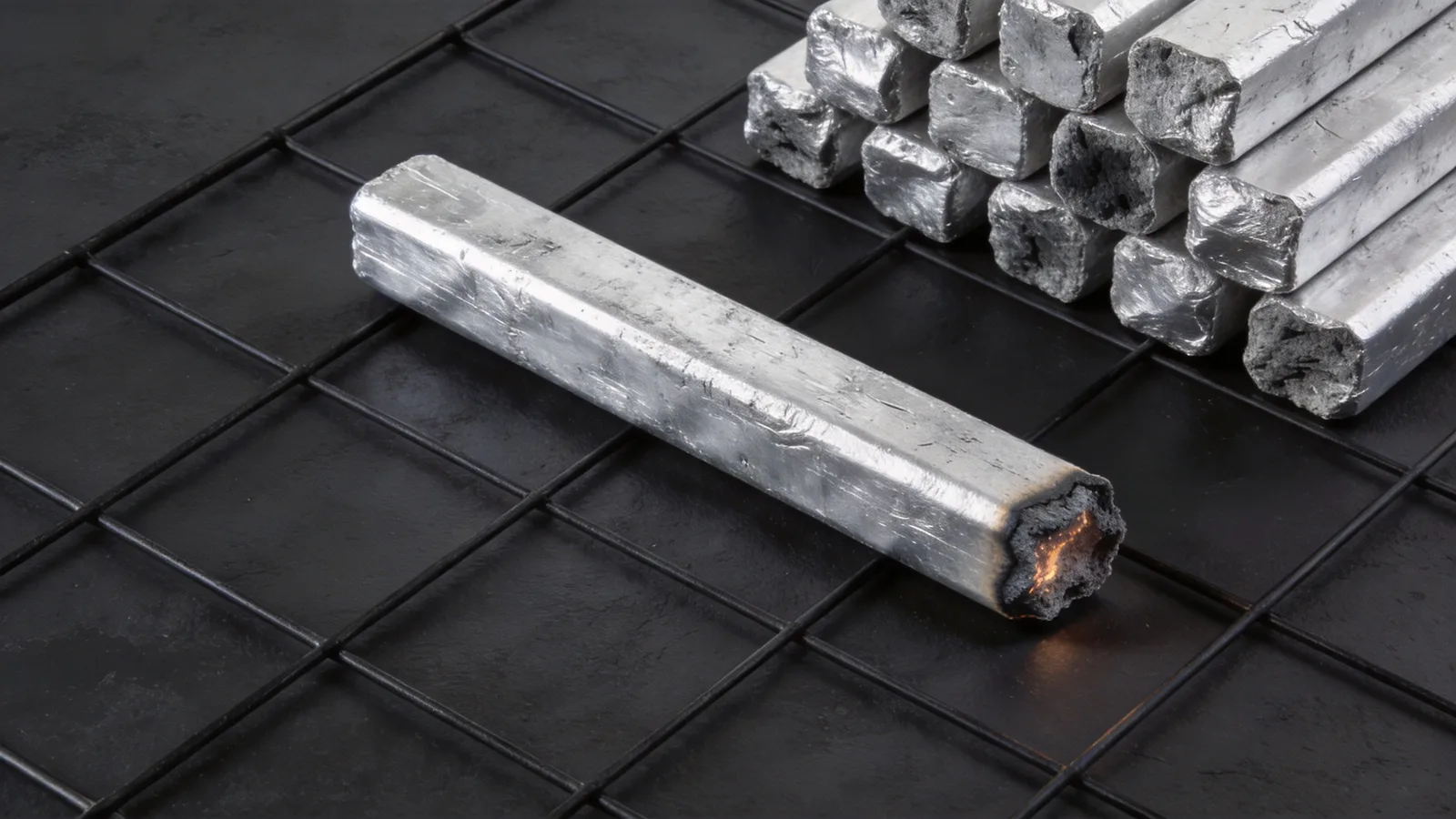
| SI87 | 90 × 25 × 12 mm silver bar | 90–110 min | 35–45 s | 3.5–4.5% | 60 pcs/box, 24 boxes per carton |
What the Datasheet Does Not Say
The gaps matter as much as the numbers. In all three records, fixed carbon and volatile matter are null — the two fields that would let a buyer compare bamboo against coconut on fuel fraction rather than on burn claims. The datasheet also leaves these unresolved:
- Calorific unit. Values are stated in "J" — 6,500–7,450 for SL470, 7,500 for C25, 7,200–7,400 for SI87 — with no multiplier. As written the unit is ambiguous; we do not convert it.
- Test method. No ASTM, ISO or GB method is cited for any figure. Numbers without a method are not comparable across suppliers.
- Batch and date. The datasheet describes a product line, not a production batch.
- Binder and coating. Binder is not stated for the cubes; the composition of the silver coating on SI87 is not stated either.
- Density and hardness basis. "Hardness 95%" appears in the datasheet with no test definition.
Which Format Suits Which Job
SL470 is the large-format cube: 40 × 40 × 30 mm, about three times the volume of a 25 mm cube (48,000 mm³ against 15,625 mm³). The larger mass supports the declared 2–3 hour burn and suits long sessions or large bowls where refuelling is disruptive. It also takes longer to reach full glow and needs a bowl that can seat it.
C25 is the standard 25 mm cube — the most widely used hookah size, and the format that fits the majority of bowls. It is the closest bamboo equivalent to the 25 mm coconut record, which makes it the natural head-to-head comparison when you sample.
SI87 is a coated bar with a 35–45 second ignition window, which places it in the quick-light class rather than the natural-cube class. That speed comes from the coating; if you need an uncoated product, this is not it. It is also the only record that lists incense alongside hookah as an application.
Bamboo charcoal is also used as grilling fuel and for incense in some markets, but no BBQ-specific bamboo record exists in our database — that field stays data pending. For grilling formats, see BBQ charcoal.
Where Bamboo Quality Goes Wrong
- Low density, short burn. Lighter feedstock means less heat per piece; a cube that looks identical to coconut can die noticeably sooner.
- Higher ash. The declared 3.5–5% band is wider and higher than the coconut record's ≤ 3.5%. More residue per session, and a wider spread between good and bad cartons.
- Coating inconsistency. Silver-coated bars depend on an even coat for the fast-light claim; patchy coating shows up as uneven ignition across a box.
- Breakage. Bars are thin in one dimension and snap; cubes chip at the edges. Inspect a middle carton, not the top layer.
- Moisture pickup. Bamboo char is hygroscopic like any charcoal; a failed liner shows up as slow lighting on arrival.
- Category confusion. Fuel-grade bamboo charcoal is not the same product as bamboo charcoal sold for filtration or deodorising. Specifications do not transfer.
Buyer Checklist
- Confirm the format. Cube or bar, exact dimensions, and the tolerance around them.
- Ask for fixed carbon and volatiles. Both are missing from the current datasheet — that is the first gap to close.
- Resolve the calorific unit. Ask for the value with a multiplier and the basis (dry or as-received).
- Name the method. ASTM / ISO / GB for every chemistry figure, or the number is not comparable.
- Declare the coating and binder. Especially for the silver bar, where ignition speed depends on the coat.
- Test ignition and burn yourself. Bamboo's advantage is fast lighting; confirm it on your burner, not on the datasheet.
- Inspect the middle carton. Breakage and fines hide at the bottom of the pallet.
- Acceptance clause. Agree sampling and the remedy for an out-of-spec arrival before ordering.
Sampling and Verification Path
Compare C25 against a 25 mm coconut cube in the same session — same bowl, same burner, same session length — and record ignition, peak heat and total usable burn. That single side-by-side tells you more than any datasheet comparison.
- Request a sample in the format you intend to buy. Sample request form →
- Burn it in your own setup and write down what happens, including ash volume and odour.
- Ask for a batch test report before the bulk order, then repeat the check on the arrived container.
Method references are on the testing sub-site; structured records are in the product database.
Verification Status
No bamboo charcoal product has been independently verified by Charcoal Hub. All three records are supplier-declared from a FireMax datasheet provided by the site operator; no certificate, laboratory report or factory audit is on file, and no manufacturer is named as verified. Reports, when attributable, will be published on the testing sub-site.
Frequently Asked
Is bamboo charcoal the same as bamboo "charcoal" for air purification?
No. The records on this page describe fuel-grade bamboo charcoal pressed into hookah cubes and bars. Bamboo charcoal sold for air purification, humidity control or water treatment is a different product grade with different processing and different claims. Do not treat one as a substitute for the other.
Why does the datasheet give calorific value in joules?
The FireMax datasheet states "J" without a multiplier, which is not a usable calorific unit — the same figure would mean different things as J/g, kJ/kg or cal/g. Charcoal Hub reproduces the number as stated and does not convert it. Treat the calorific field as unresolved until the supplier confirms the unit and basis in writing.
Are these bamboo products verified?
No. All three records carry supplier-declared status: the figures come from a FireMax datasheet provided by the site operator, and none has been independently tested by Charcoal Hub. No certificate, laboratory report or factory audit sits behind them.
Can I order a printed retail box?
Private label is possible in principle, but no MOQ or artwork process has been declared for these three products — the field is recorded as pending. Ask for the packaging run, plate cost and proofing sequence before committing to artwork.
Related
C25 product record data
25 mm bamboo cube with supplier-declared values and status.
Ignition time methodology data
Why ignition time is a system property and how to compare it.
Ignition test method testing
How ignition time is assessed under defined conditions.
Quick-light vs natural knowledge
What coating does to ignition, and what it changes in the session.
25 mm vs 26 mm knowledge
How a millimetre changes mass, count and burn per cube.
Odour and ignition knowledge
What drives odour and ignition behaviour in charcoal.
Coconut shell charcoal
The denser alternative, with a full declared chemistry table.
OEM sourcing
How a private-label programme is specified and run.
Request samples
Verify a batch yourself before committing to volume.