
Hookah Charcoal Manufacturing: Quality, Density and Consistency
A hookah cube is decided at the press and the dryer, not at the packing table. This guide walks the production line stage by stage, shows which parameter each stage fixes, and turns the vague claim of “factory quality” into checks a buyer can actually run.
Process ranges below are industry references, not one factory’s settings. No independent audit report for a named plant is on file. Request a quote →
Supplier-declared means a figure comes from a supplier listing or datasheet and has not been independently tested by Charcoal Hub. Industry reference means a class-level range from public process sources — orientation, not a commitment from any plant. Data pending means no figure is published for that field. Method definitions live on the testing sub-site.
What Manufacturing Quality Means in Hookah Charcoal
Buyers often describe quality as a feeling: the cube lights evenly, holds its shape, does not smell, and leaves a fine grey ash instead of a crust. Those are real outcomes, but they are outputs of a process. A manufacturing claim is only useful when it can be traced back to a stage that was controlled and a record that proves it.
In practice, “quality” in this product means two different things, and they are frequently confused. The first is conformance: does this batch meet the declared ash, moisture, size and density limits? The second is consistency: does the next batch meet them too? A single perfect laboratory report answers the first question for one lot. Only a run of batch records answers the second.
That distinction matters commercially. A buyer who qualifies on one sample and then orders a container is trusting a process they have never seen. The sections below are arranged in production order so that each claim can be attached to the stage that creates it — and so that a plant visit or a video call has a structure.
The Line, Stage by Stage
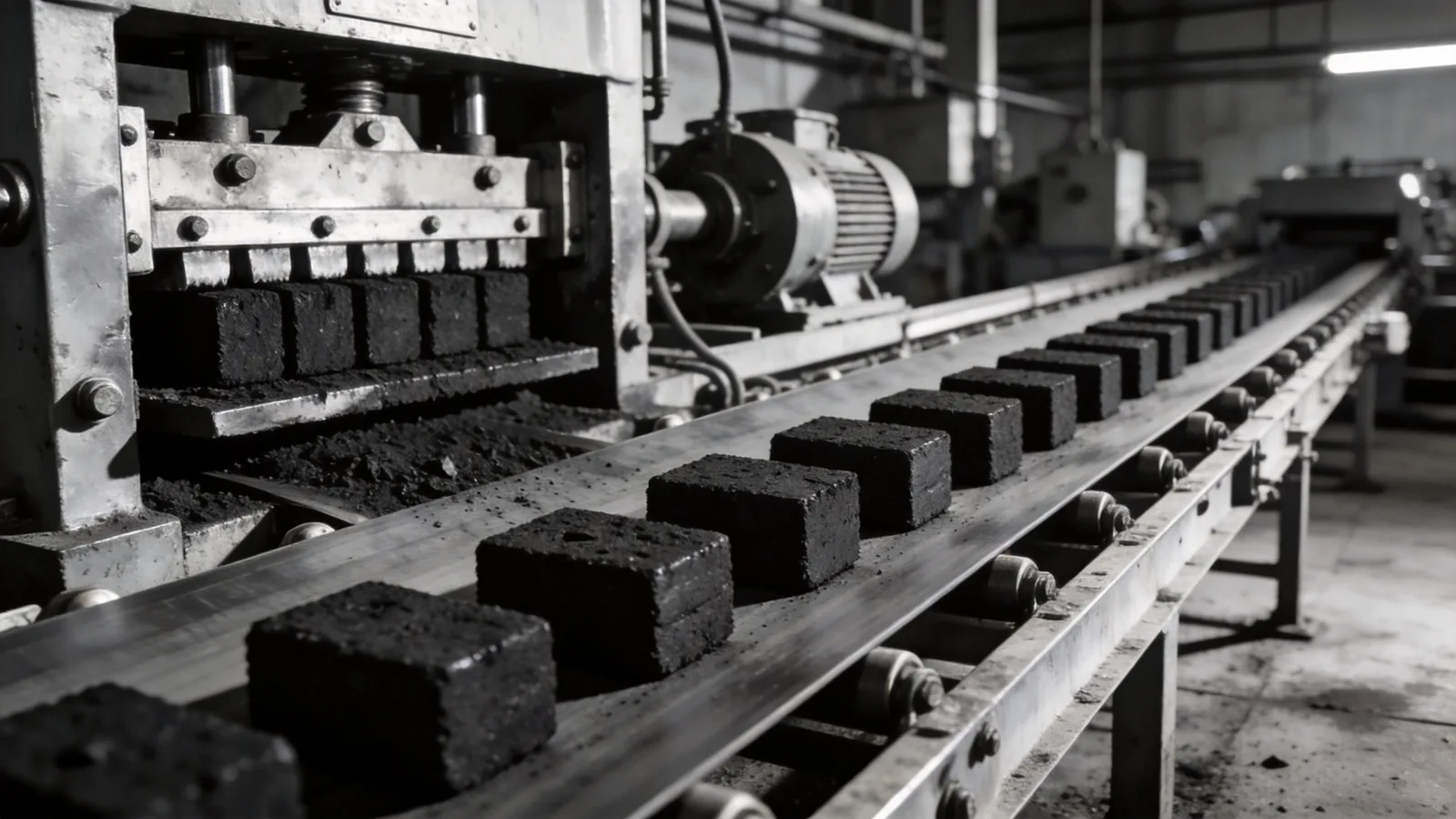
The conventional line for pressed coconut shell hookah charcoal runs through seven stages. Each one leaves a fingerprint on the finished cube, and each one has a characteristic failure mode that shows up later as a complaint.
| Stage | What it fixes | Characteristic failure |
|---|---|---|
| Shell intake and screening | Ash precursor, contamination | Sand, fibre or mixed feedstock raises ash and causes sparks |
| Carbonisation | Volatile matter, fixed carbon, yield | Under-carbonised char smokes and smells; over-carbonised char wastes yield |
| Milling and screening | Particle size distribution, packing behaviour | A coarse or drifting grind gives soft cubes and uneven burn |
| Binder mixing | Green strength, ash, odour | Too much binder softens the cube and lifts ash; the wrong binder adds a note |
| Pressing and cutting | Density, nominal size, shape | Die wear drifts dimensions; low pressure gives a crumbly cube |
| Drying and conditioning | Moisture, crack formation, hardness | Fast drying cracks cubes; under-drying ships soft, smoky product |
| Sorting and packing | Fines removal, count, barrier | Fines left in the box read as breakage at arrival |
The order is not arbitrary: a defect introduced at carbonisation cannot be fixed at packing, and an under-pressed cube cannot be rescued by longer drying.
Carbonisation: Where Ash and Fixed Carbon Are Decided
Coconut shells are heated in a kiln, retort or drum with limited oxygen. Public process references put the effective window at roughly 600–900 °C Industry reference. Inside that window, volatile matter is driven off as gas and what remains is a carbon skeleton — the material that carries fixed carbon.
Two things are decided here that buyers care about most. The first is volatile matter. Incomplete carbonisation leaves volatiles behind, and those volatiles are the closest laboratory proxy for start-up smoke and odour. A cube made from under-carbonised char can look perfect and still taste wrong. The second is ash, but indirectly: ash is mineral matter from the shell, and because carbonisation removes mass, the same minerals become a larger percentage of the finished char. Clean, screened shells are therefore the cheapest ash control available.
Yield is the commercial counterweight. Public references place the shell-to-charcoal ratio at roughly 2–2.5 tonnes of shells per tonne of char Industry reference. Push carbonisation harder and yield falls; that cost reappears in the price or the binder share.
Feedstock moisture matters before the kiln, not after. Process references describe shells being dried to roughly 20% or below before carbonisation Industry reference, because wet shells carbonise slowly and unevenly. A plant that stores shells in the open will produce char that varies with the weather — and no downstream stage fully corrects for that.
For buyers, the practical question is who owns this stage. Some suppliers carbonise in-house; others buy carbonised shell powder and run only the forming line. Neither is dishonest, but the second model means ash and volatile matter are inherited from a third party, and batch traceability has an extra link. Ask directly, and ask for the char supplier’s specification if the answer is “we buy powder”. The process explainer covers the same chain from the feedstock side.
Milling, Binder and Moisture in the Mix
Carbonised shell is ground before it can be pressed. The grind is a real specification variable even though it rarely appears on a datasheet. A finer, more uniform powder packs more tightly and produces a harder green cube, but it also needs more water and can change how the finished cube burns. A coarse or drifting grind gives a soft cube, a rough surface and inconsistent density inside the piece.
The binder is usually food-grade tapioca or cassava starch: the glue that holds the cube together and burns away with the fuel. Its share affects green strength, ash after combustion and sometimes odour during lighting. More binder makes a tougher cube and a higher ash residue, which is why “low ash” and “extra hard” claims belong together.
Water in the mix is process water, not product moisture. It makes the paste workable and is removed in the dryer. Confusing the two is a common source of bad specifications: a buyer asks for “5% moisture” and the supplier measures the wet mix instead of the finished cube. Always state that the moisture limit applies to the dried, packed product.
If a supplier claims a binderless cube, ask how it holds together without one and what the drop-test result is. Some products are pressed from char with enough natural tars to bind; many “binderless” claims are simply a different starch that is not declared. Neither answer is automatically disqualifying, but the answer should be specific.
Pressing: Density, Die Wear and Size Drift
The press turns paste into a cube. Pressure is the main lever on density, and density is the property a buyer feels first: a dense cube has weight in the hand, survives handling and burns longer for its size. Public process references place pressed shisha briquettes in a working range around 1.2–1.3 t/m³ Industry reference. Treat that as an orientation band, not a purchase limit — it is a class-level figure, not a factory guarantee.
Size is set by the die, and dies wear. Across a long production run the cavity enlarges slightly, so cubes pressed at the end of a run can measure larger than cubes pressed at the start. This is the mechanical reason a nominal “25 mm” label is not a tolerance. It is also why an in-process dimension check at the start, middle and end of a run tells you more than a single measurement on a single sample.
Green strength — the strength of the cube before drying — is an intermediate the buyer never sees, but it predicts the arrival condition. A cube that is fragile when wet tends to crack in the dryer and shed fines in the carton. Press pressure, binder share and particle size all feed into it.
Drying and Conditioning: The Arrival Risk
Drying is the least glamorous stage and the one most likely to decide whether the container arrives in sellable condition. Public process references describe finished hookah cubes drying to roughly 6–8% moisture Industry reference, with some buyers specifying a tighter ceiling at the factory gate. The exact target matters less than the control: a uniform, measured endpoint beats a nominal number achieved unevenly.
Two failure modes sit on either side of the target. Under-drying leaves water in the cube: it lights slowly, smokes more, weighs more than it should and can develop mould in a warm container. Over-drying — especially fast, high-heat drying — creates a moisture gradient, and the shrinkage stress shows up as hairline cracks after handling.
Drying method changes uniformity. Oven or tunnel drying gives a controlled, repeatable curve; sun drying depends on weather and turns out a batch that varies day to day. For a container order, the difference is not cosmetic: it is the difference between a moisture figure you can put in a contract and one you hope holds.
Charcoal is hygroscopic, so a cube that leaves at 6% moves toward equilibrium with the humidity around it in transit. Packaging therefore belongs in the moisture specification, and an arrival check belongs in the purchase terms. The moisture guide sets out the measurement and storage detail.
Density: Three Different Numbers
“Density” is used for at least three different measurements in this trade, and a datasheet rarely says which one it means. The numbers are not interchangeable, and comparing them across suppliers is a reliable way to reach a wrong conclusion.
| Measure | What it describes | What it decides |
|---|---|---|
| Bulk density | Mass of a loosely filled or settled volume of cubes, typically kg/m³ | Container loading and freight per tonne |
| Particle (apparent) density | Mass of one piece divided by its envelope volume | How much fuel sits in a cube of a given size |
| Piece mass | Weight of a single cube, in grams | The quickest field check, and the basis for pieces per kilogram |
The consequences run in different directions. Higher bulk density fits more tonnes into a container, which lowers freight per tonne — a logistics win that says nothing about how the cube burns. Higher particle density means more carbon per piece, and generally a longer, steadier burn. A heavier piece can be either, or simply absorbed water.
That last point catches buyers repeatedly. Water adds weight without adding fuel. A cube that has taken up moisture feels dense and performs badly — slow to light, smoky, and short on usable heat. Density figures should therefore always be read next to moisture, and a measured density should state whether it is on a dry basis.
For a practical check, weigh ten random cubes and measure them with calipers. The spread in piece mass at a fixed nominal size is a direct read on press consistency, and it takes two minutes. The density and heat management guide connects the number to session behaviour.
Consistency: Batch Variation and What It Looks Like
Consistency is a process property, and it fails in two directions. Within a batch, the symptoms are visible: a spread of cube sizes in one carton, a mix of shades, some pieces noticeably heavier, cracks or chipped corners. Between batches, the symptoms are quieter and more expensive: ash drifts up half a point, burn time shortens, a customer notices the session changed.
The sources of drift are ordinary: a new shell supplier changes the mineral load, a different char lot changes volatile matter, a binder delivery changes green strength, humid weather changes drying, a worn die changes size. None is a scandal; all are invisible unless the plant records them.
This is why a single certificate is weak evidence and three consecutive batch records are strong. Ask for the same fields across three batches — ash, moisture, volatile matter, fixed carbon, size check, density or piece mass — and look at the spread rather than the average. A supplier whose three batches sit in a narrow band is controlling the line. A supplier whose values wander is running a process that happens to have produced a good sample.
Two visual shortcuts are worth discarding. Colour is not a grade: it responds to carbonisation temperature, binder share and drying, and two cubes of the same shade can differ in ash and density. Surface gloss is not a guarantee either — a polished look can come from a die, a coating or a tumbling step, and none of those is a specification. Judge mass, dimension, hardness, ash and a burn test; leave appearance out of the qualification.
The QC Plan: Stage Gates and Records
A workable plan is short: a check at each stage where a parameter is fixed, recorded against a batch number so it can be traced to the cartons it covers. The table is a buyer’s version of that plan — what to require, not a claim about any supplier’s practice.
| Gate | Check | Record that makes it useful |
|---|---|---|
| Shell intake | Source, cleanliness, moisture before carbonisation | Supplier lot, date, moisture reading |
| Carbonised char | Volatile matter, ash, appearance, unburnt shell | Kiln run ID and result per run |
| Milled powder | Particle size, uniformity, foreign matter | Sieve result or grind setting log |
| Mix | Binder type and share, water addition | Recipe version and batch weight |
| Pressed green | Piece mass, dimensions, green strength | Start / middle / end-of-run measurements |
| Dried | Moisture, cracks, hardness | Dryer curve and final moisture per lot |
| Packed | Fines, count per box, seal integrity | Carton count and sample photos |
| Pre-shipment | Fresh sample, dimensions, moisture, DG labels | Inspection report with container number |
The record is the part that gets skipped. A QC sheet with numbers but no batch ID cannot be tied to the cartons in front of you, and a test result from “last month” describes a different lot. Ask for the batch number on the packing list to match the QC sheet, and reject the shipment if it does not.
Sampling discipline matters as much as the test. Samples taken from the top layer of a pallet are not a sample of the load. A working plan takes pieces from several cartons across the pallet, and for a container, from more than one position in the stow. The pre-shipment inspection guide sets out the sequence, including the dangerous-goods labelling check.
Process Claims, Defects and What They Reveal
A defect is more useful than a compliment. Each symptom below points to a stage, and the stage tells you which question to ask. The mapping narrows the conversation; it is not a diagnosis.
| Symptom | Likely stage | Question to ask |
|---|---|---|
| Cubes crumble or shed dust in the box | Pressing, binder, drying | What is the drop-test or durability result for this size, and what fines limit applies? |
| Hairline cracks after arrival | Drying | What is the dryer curve, and is moisture measured before or after conditioning? |
| Size spread inside one carton | Pressing, die wear | Are dimensions checked at the end of the run, and what tolerance band is guaranteed? |
| Sparks during lighting | Shell intake, screening | How is feedstock screened for sand and foreign matter? |
| Chemical or solvent note | Binder, coating, carbonisation | What exactly is in the binder, and is there any accelerant layer? |
| Smoky start, ash-heavy session | Carbonisation, moisture | Volatile matter and moisture for this batch, with method and basis? |
| Uneven glow across a cube | Mixing, pressing | Is density checked within a piece, or only as a batch average? |
The same logic applies to marketing language. “Smokeless” is not a measurable property — volatile matter and a session test are. “100% natural” says nothing about the binder unless the binder is named. “Export grade” has no legal definition; “premium” is a price signal. None of these is proof of a problem; they are simply not evidence. Evidence is a batch record, a named method, a stated basis and a sample you burned yourself.
Specifying Quality in the Purchase Order
The manufacturing detail only becomes enforceable when it is written into the order. A workable annex has five parts: the field, the limit, the method, the basis and the status (maximum, minimum or typical). Anything missing is a conversation, not a term.
Start with the fields that decide the product: cube size and tolerance, piece mass or density, moisture at packing, ash maximum, volatile matter maximum, fixed carbon minimum, and a named binder. Add the sensory items you can evaluate — a blind session test for odour and ignition — and record the result rather than describing it in adjectives.
Then define the batch. One production run per shipment, or a declared split, is far easier to inspect than a blended load. Agree the sampling plan, the laboratory or method, the acceptance limits and the remedy: replacement, credit or rework. A specification without a remedy is a wish.
For a private-label order, make the pre-production sample a formal gate. A screen proof will not show registration on moisture-resistant board; a first article from the actual line will. The private label process covers artwork, MOQ and approval; the private-label guide covers the commercial side.
Finally, inspect before shipment. Sample from the middle of the load, verify carton integrity and UN 1361 Class 4.2 marking, and photograph the lot with the container number visible. A photo set is the cheapest dispute insurance in the trade, and it costs nothing to require.
We publish no price list or fixed MOQ, because both depend on specification, packaging and destination. Describe the cube, the volume and the market. Any figure without evidence — a density reading, a batch history, a binder declaration — stays Data pending.
Frequently Asked Questions
How can I tell whether a supplier actually manufactures or just repacks?
Ask three process questions: where the carbonised shell comes from, what pressing equipment is used, and how drying is controlled. Then ask for a QC sheet whose batch number matches the packing list. A factory can produce that record; a trader usually forwards a datasheet instead.
What density should hookah charcoal have?
Public process references place pressed shisha briquettes in a working range of roughly 1.2–1.3 t/m³, but the figure is only meaningful with its method. Bulk density decides container loading; particle density describes a single cube. Ask which one is quoted, then confirm by weighing a sample cube and measuring it with calipers.
Why does cube size vary inside one carton?
Nominal size is a die dimension, not a guarantee. Die wear, paste moisture, press pressure and drying shrinkage all move the finished dimension across a run, so a supplier who checks only at the start ships cubes at the edge of the band. Specify a tolerance and a sampling plan, not just a size.
Is a darker cube a better cube?
No. Colour responds to carbonisation temperature, binder share and drying, and it is not a specification. Two cubes of the same colour can differ in ash, density and burn behaviour. Judge weight, hardness, dimension, ash and a burn test — not shade.
What causes sparks or a chemical smell when lighting?
Sparks usually point to feedstock contamination — sand, shell fibre or foreign material that survived screening. A chemical or solvent note is more often an accelerant coating, an industrial binder, or incomplete carbonisation leaving volatiles. Both are process signals, and both are reasons to test a sample rather than accept a datasheet.
If you are still selecting a product, start with the hookah charcoal page or the coconut shell category. If you have a specification, the next useful step is a sample and a quote. If you are auditing a plant, take the gate table above as the interview script.
The declared values behind this product family live in the 25 mm product record, with the same status legend applied to every field. The testing sub-site explains how each property is measured, and the manufacturer verification model explains what a profile does and does not prove.
Hookah charcoal product
Cube sizes, session behaviour and what to verify before ordering.
Coconut shell charcoal product
The feedstock-to-cube category and its declared records.
Private label service
Artwork, MOQ and the pre-production sample gate.
Test methods testing
How density, moisture, ash and durability are actually measured.
How to choose knowledge
A buyer decision framework for hookah charcoal.
Request a quote
Send size, volume, packaging and destination port for a specification-based offer.